

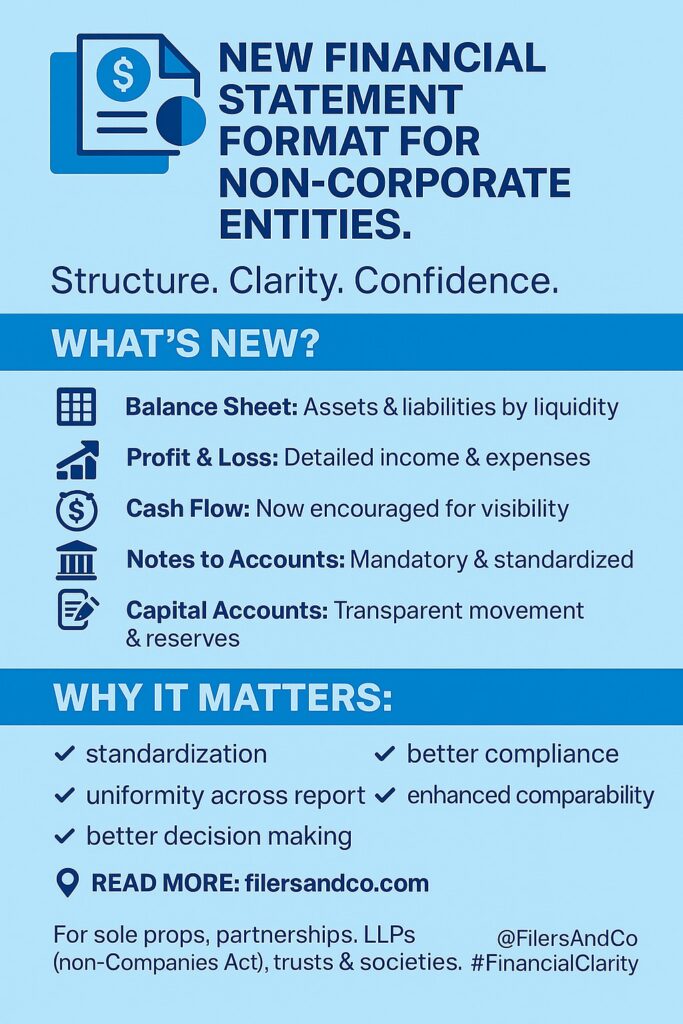
If you’re running a sole proprietorship, partnership firm, LLP (not governed by the Companies Act), trust, or society, there’s a good chance you’ve been preparing your financials in a format that’s worked for years—but maybe lacked structure or consistency. That’s changing.
To bring more clarity, transparency, and comparability to financial reporting, the Institute of Chartered Accountants of India (ICAI) has introduced a new format for financial statements specifically for non-corporate entities. This move is designed to help even small and medium-sized businesses present their financials in a more standardized and professional way.
Let’s walk through what’s changed, how it compares to the old format, and why it matters.
🧾 Balance Sheet: From Chaos to Clarity
🏚 What the Old Format Looked Like:
- No fixed structure—everyone had their own way.
- Assets and liabilities were often listed in the order of permanence (starting with fixed assets).
- Loans and advances were lumped together, regardless of when they were due.
- Fixed and intangible assets weren’t clearly separated.
- In partnerships, capital accounts often included drawings and reserves all mixed together.
🏢 What’s New:
- Assets and liabilities must now be classified based on liquidity—just like in company financials.
- Assets are split into:
- Non-current assets (like machinery, long-term investments)
- Current assets (like cash, receivables)
- Liabilities are also split into:
- Non-current liabilities (like long-term loans)
- Current liabilities (like creditors, short-term borrowings)
- Clear distinctions are made between:
- Property, Plant & Equipment (with depreciation shown separately)
- Intangible Assets (like goodwill, trademarks)
- Investments (split into long-term and short-term)
- Loans and advances are now categorized based on when they’re expected to be recovered.
- Partner’s capital accounts are shown with a full reconciliation:
- Opening balance
- Add: Capital introduced
- Less: Withdrawals
- Add/Less: Share of profit/loss
- Closing balance
💡 Why This Matters:
This structure makes it easier for banks, investors, and even internal stakeholders to understand the financial health of the business—especially when it comes to liquidity and long-term stability.
📈 Profit & Loss Statement: More Detail, More Insight
🏚 Old Format:
- Revenue was often shown under a single head like “Sales” or “Operating Income.”
- Other income (like interest or rent) was either hidden or misclassified.
- Expenses were grouped under vague headings like “General Expenses.”
- No separate treatment for exceptional items or prior period adjustments.
- Depreciation was inconsistently reported.
🏢 New Format:
- Revenue from operations is now broken down into:
- Sale of goods
- Rendering of services
- Other core business income
- Other income is shown separately and includes:
- Interest income
- Dividend income
- Rent received
- Miscellaneous income
- Expenses are categorized by function and nature:
- Cost of materials consumed
- Changes in inventories
- Employee benefit expenses
- Finance costs
- Depreciation and amortization
- Other expenses (with details in the Notes)
- Exceptional and extraordinary items are shown as separate line items.
- Standard disclosure of:
- Earnings Before Tax (EBT)
- Tax Expense
- Profit After Tax (PAT)
💡 Why This Matters:
This level of detail helps stakeholders understand where the money is coming from and where it’s going. It also makes it easier to analyze profitability, cost control, and operational efficiency.
💵 Cash Flow Statement: Encouraged, Not Enforced
🏚 Old Format:
- Rarely prepared by non-corporate entities.
- If prepared, it usually followed the indirect method.
- No standard format, making it hard to interpret.
🏢 New Format:
- Now encouraged (especially for larger non-corporate entities, classified as Level I by ICAI).
- Can be prepared using either:
- Direct method (actual cash inflows and outflows)
- Indirect method (adjusting net profit for non-cash items)
- Structured into three parts:
- Operating activities
- Investing activities
- Financing activities
- Includes reconciliation with closing cash and cash equivalents.
💡 Why This Matters:
A cash flow statement gives a real-time view of how cash is moving through the business. It’s a powerful tool for decision-making and shows whether profits are actually translating into liquidity.
📚 Notes to Accounts: No Longer Optional
🏚 Old Format:
- Often minimal or inconsistent.
- Accounting policies were generic or missing.
- Contingent liabilities and related party transactions were rarely disclosed properly.
🏢 New Format:
- Notes to Accounts are now a must-have.
- Must include:
- Significant accounting policies (like depreciation methods, inventory valuation)
- Disclosures required by applicable Accounting Standards
- Contingent liabilities and commitments
- Related party disclosures (nature of relationship, transactions, balances)
- Segment reporting (if applicable)
- Notes must support the numbers in the main financials with:
- Breakups of fixed assets
- Investment classifications (quoted/unquoted, current/non-current)
- Loan terms and conditions
💡 Why This Matters:
These disclosures provide context and clarity. They help users of financial statements understand the assumptions behind the numbers and any potential risks or obligations.
🏦 Capital and Reserves: Cleaner and More Transparent
🏚 Old Format:
- Partner capital and drawings were often netted off.
- Reserves and surpluses were clubbed together.
- No clear treatment for revaluation reserves or appropriations.
🏢 New Format:
- Capital accounts are shown separately, with detailed movements.
- Drawings and interest on capital/loans are disclosed clearly.
- Reserves are categorized:
- Capital Reserve
- Revaluation Reserve
- General Reserve
- Surplus from the Profit & Loss account is shown under a separate head, after appropriations.
💡 Why This Matters:
This structure gives a clearer picture of ownership, retained earnings, and how profits are being used or distributed.
✨ Other Notable Enhancements
- Materiality Principle: Minor items can be grouped, while significant ones must be disclosed in detail.
- Rounding Off: Consistent use of rounding (in thousands or lakhs) for better readability.
- Comparative Figures: Prior year’s numbers must be shown for each line item to aid comparison.
📊 Classification of Non-Corporate Entities: Level I to Level IV
| Level | Criteria | Entity Type | Compliance Requirement |
| Level I | Any one of the following: • Listed or in the process of listing on any stock exchange (India or abroad) • Banks, financial institutions, or insurance companies • Turnover > ₹250 crore (excluding other income) in the preceding year • Borrowings > ₹50 crore at any time during the preceding year • Holding or subsidiary of any of the above | Large entities | Must comply fully with all Accounting Standards issued by ICAI |
| Level II | Not Level I, but any one of the following: • Turnover > ₹50 crore and ≤ ₹250 crore • Borrowings > ₹10 crore and ≤ ₹50 crore • Holding or subsidiary of any of the above | Medium-sized entities | Eligible for certain exemptions/relaxations from select Accounting Standards |
| Level III | Not Level I or II, but any one of the following: • Turnover > ₹10 crore and ≤ ₹50 crore • Borrowings > ₹2 crore and ≤ ₹10 crore • Holding or subsidiary of any of the above | Small-sized entities | Eligible for more exemptions/relaxations than Level II |
| Level IV | Not covered under Level I, II, or III | Micro entities | Eligible for maximum exemptions/relaxations under ICAI Accounting Standards |
📝 Additional Notes:
- These classifications are based on the entity’s status at the end of the relevant accounting period.
- If an entity moves from one level to another, it must comply with the new level’s requirements from that period onward.
- Entities availing exemptions must disclose:
- Their classification level (e.g., Level III MSME)
- That they’ve complied with applicable standards for that level
- If an entity opts out of exemptions, it must comply fully with the relevant standards and disclose this choice.
🎯 Key Benefits of the New Format
| Benefit | Why It Matters |
| Standardization | Aligns with company formats, making financials easier to understand and compare. |
| Better Decision-Making | More detailed data helps stakeholders make informed choices. |
| Improved Compliance | Easier to meet audit, tax, and regulatory requirements. |
| Enhanced Comparability | Firms in the same industry can now be benchmarked more effectively. |
| Professional Image | Elevates how non-corporate entities are perceived by banks, investors, and clients. |
| Uniformity and Comparability | The ICAI’s new guidance ensures uniformity and comparability in non-corporate entities’ financial statements by prescribing standardized formats and disclosure norms effective from FY 2024–25. |
🧠 Final Thoughts
This new format isn’t just about ticking boxes—it’s about telling a clearer, more credible financial story. Whether you’re a tax consultant, an accountant, or a business owner, adopting this structure can help you present your numbers with confidence and precision.
For professionals, it’s a chance to guide clients through a more transparent reporting process. For businesses, it’s a step toward building trust and long-term credibility.


